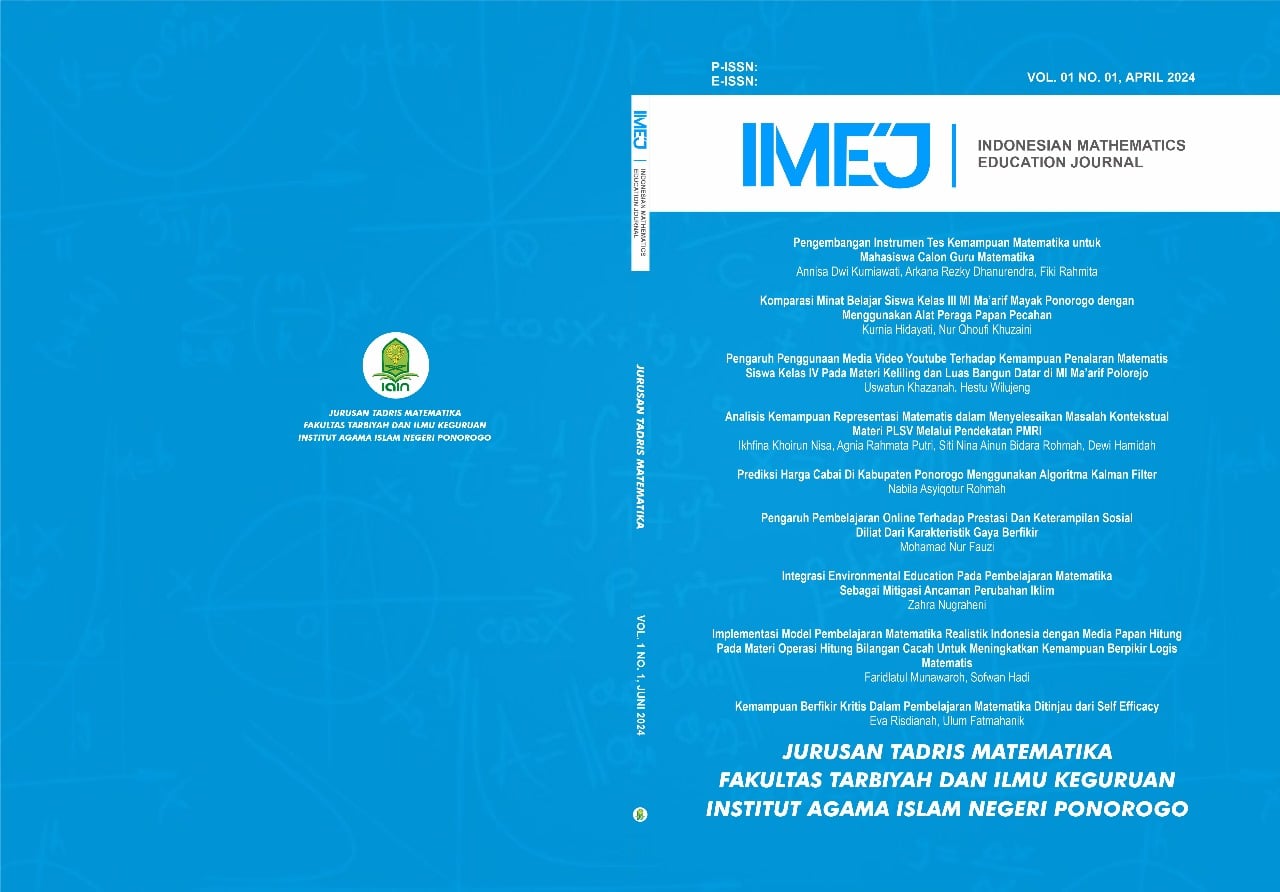
Komparasi Minat Belajar Siswa Kelas III MI Ma’arif Mayak Ponorogo dengan Menggunakan Alat Peraga Papan Pecahan
DOI:
https://doi.org/10.21154/imej.v1i01.1Keywords:
Learning Interest, Fraction Board PropsAbstract
Interest is a person's favourite, favourite thing about something. The tedious learning process of mathematics tends to make students less interested in learning material, so one of the efforts made in the learning process is by using fraction board props on simple fraction material. The research method used is a comparison with the independent sample t-test. The research was conducted at MI Ma'arif Mayak Ponorogo with a sample size of 50 students consisting of 2 classes, namely class 3a as the experimental class and class 3b as the control class. The data collection technique used a questionnaire—technical data analysis using quantitative descriptive data and inferential statistics. The results of the study are 1) the learning interest of MI Ma'arif Mayak Ponorogo students who use fraction board props in the high category 8%, medium category 84% and low category 8%; 2) the learning interest of MI Ma'arif Mayak Ponorogo students who do not use fraction board props in simple fraction material in the high category 20%, medium category 64%, and low category 16% and 3) There is a significant difference between the learning interest of MI Ma'arif Mayak Ponorogo students who use and do not use the fraction board props with t-count 3.159 and t-table 2.201 at the 5% significance level.
Downloads
Downloads
Published
Issue
Section
License
Copyright (c) 2024 IMEJ : Indonesian Mathematics Education Journal

This work is licensed under a Creative Commons Attribution-NonCommercial 4.0 International License.
Authors who publish with this journal agree to the following terms:
- Authors retain copyright and grant the journal the right of first publication with the work simultaneously licensed under Creative Commons Attribution-NonCommercial 4.0 International License that allows others to share the work with an acknowledgment of the work's authorship and initial publication in this journal.
- Authors are able to enter into separate, additional contractual arrangements for the non-exclusive distribution of the journal's published version of the work (e.g., post it to an institutional repository or publish it in a book), with an acknowledgment of its initial publication in this journal.
- Authors are permitted and encouraged to post their work online (e.g., in institutional repositories or on their website) prior to and during the submission process, as it can lead to productive exchanges, as well as earlier and greater citation of published work (See The Effect of Open Access).
Reproducing Published Material from other Publishers
To ensure that published materials are properly cited and used, the authors are required to obtain permission to reproduce images, schematics, tables, or text excerpts that are not in the public domain or for which they are not copyrighted. The copyright holder, usually the publisher, must be contacted to obtain permission. Copyright holders can be identified by referring to individual publication imprints. Obtaining permission is necessary to avoid copyright infringement and to ensure that all relevant sources are properly cited.
The following actions require permission:
- Reproduction of your work by another publisher if you do not own the copyright.
- Use large portions of another person's work, either from a single work or multiple works in a series.
- Use of unaltered or slightly modified tables, graphs, charts, schematics, and artwork.
- Use of photographs for which you do not have copyright.
It is not necessary to obtain permission for the following reasons:
- If you reconstruct a table using data that has been published elsewhere, you must cite the source as “Data from...” or “Adapted from...” However, permission was not required for this case.
- Fairly brief citations are considered fair and do not require permission.
- If the author redraws the graph, chart, schematic, or artwork and changes it so significantly that it is no longer recognizable, permission is not required.
Obtaining Permission
To ensure a smooth publication process, it is recommended that authors begin obtaining permission as soon as possible. If there is any uncertainty regarding the copyright, the author should apply for permission. The IMEJ: Indonesian Mathematics Education Journal publish materials from other publications without their permission.
The copyright holder may provide instructions regarding the desired form of acknowledgment. If no instructions are provided, the authors follow the style below:
“Reproduced with permission from [author], [book/journal title]; published by [publisher], [year].” This statement should be placed at the end of the caption for the table, figure, or scheme.