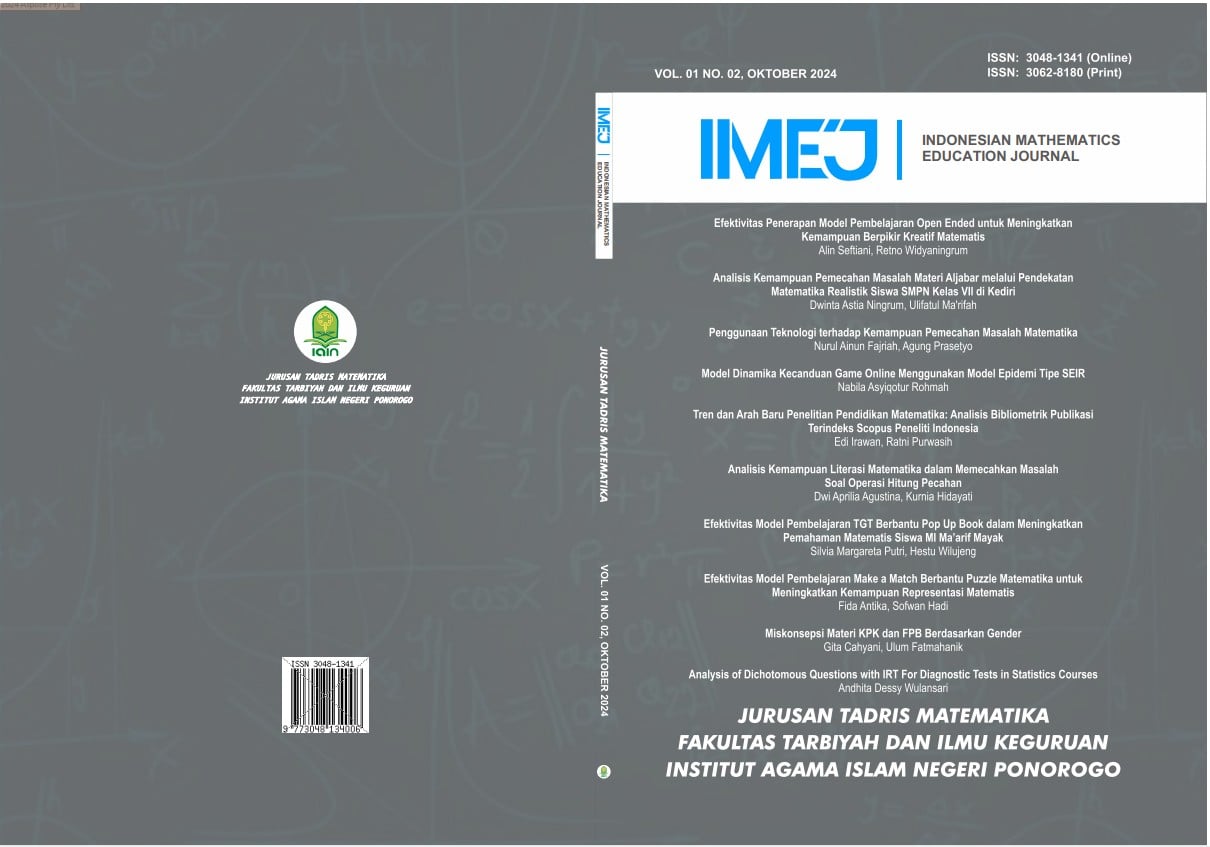
Efektivitas Penerapan Model Pembelajaran Open Ended Untuk Meningkatkan Kemampuan Berpikir Kreatif Matematis
DOI:
https://doi.org/10.21154/imej.v1i2.13Keywords:
Creative Thinking Ability, Mathematics, Open Ended Learning ModelAbstract
Berpikir kreatif matematis memotivasi seseorang untuk bersikap terbuka, percaya diri, dan melihat sesuatu dari berbagai sudut pandang sehingga memunculkan berbagai macam cara penyelesaian terhadap suatu permasalahan matematika. Hasil belajar yang belum sesuai harapan menjadi suatu objek yang menarik untuk diteliti. Seperti halnya hasil belajar matematika peserta didik kelas V MIN 1 Ponorogo yang masih belum sesuai harapan. Hal ini disebabkan masih diterapkannya model pembelajaran konvensional dalam proses belajar mengajar. Upaya untuk mengatasi hal tersebut, peneliti melakukan penelitian terhadap pembelajaran matematika dengan menerapkan model pembelajaran Open Ended untuk meningkatkan kemampuan berpikir kreatif matematis peserta didik kelas V MIN 1 Ponorogo. Penelitian ini bertujuan untuk mengetahui keterlaksanaan model pembelajaran Open Ended untuk meningkatkan kemampuan berpikir kreatif matematis peserta disik, mengetahui kemampuan berpikir kreatif matematis peserta didik, dan mengetahui efektivitas penerapan model pembelajaran Open Ended untuk meningkatkan kemampuan berpikir kreatif matematis peserta didik. Penelitian ini menggunakan pendekatan penelitian kuantitatif dengan jenis penelitian Quasi Experimental Design. Pengambilan data dilakukan dengan observasi keterlaksanaan pembelajaran dan tes. Sampel pada penelitian ini menggunakan teknik Cluster Rnadom Sampling. Sampel penelitian ini yaitu kelas V A sebagai kelas eksperimen dan kelas V B sebagai kelas kontrol. Data penelitian diolah dan dilakukan analisis menggunakan uji Independent T-test kemudian dilakukan uji N-Gain dan uji Effect Size Cohen’s D. Hasil penelitian ini yaitu (1) Penerapan model pembelajaran Open Ended pada pertemuan pertama 91% terlaksana dan pada pertemuan kedua 95% terlaksana. (2) Kemampuan berpikir kreatif matematis peserta didik kelas eksperimen yang diterapkan model pembelajaran Open Ended memperoleh nilai rata-rata post-test sebesar 76,46 lebih baik daripada kelas kontrol dengan model pembelajaran konvensional memperoleh nilai rata-rata post-test sebesar 59,17. (3) Model pembelajaran Open Ended cukup efektif untuk meningkatkan kemampuan berpikir kreatif matematis peserta didik dengan Effect Size Cohen’s D sebesar 2,056039 yang berarti memiliki efek sangat besar.
Downloads
References
Amin, L. Y. S. S. (2022). 164 Model Pembelajaran Kontemporer. Pusat Penerbit LPPM.
Fatmahanik, U. (2016). Realistic Mathematic Education (RME) Dalam Meningkatkan Hasil Belajar Matematika. Ibriez : Jurnal Kependidikan Dasar Islam Berbasis Sains, 1(1), 19–34.
Gabung, G., Ramadhana, R., & Tenriawaru, A. (2022). ARITMATIKA : Jurnal Inovasi Pendidikan Matematika STKIP YPUP Makassar Melalui Model Pembelajaran Open Ended Pada Siswa. 03, 15–18.
Guilford, J. P. (1967). The nature of human intelligence. In The Nature of Human Intelligence. McGraw-Hill.
Jumanto, J., & Adi, Y. K. (2023). Profil Kemampuan Berpikir Kreatif Peserta Didik Kelas VI Ditinjau Dari Prestasi Akademik. Jurnal Sinektik, 5(1), 82–87.
Mazida. (2021). Pengembangan Permainan Moji. Noviana Diah.
Munandar, U. (1999). Pengembangan Kreativitas Anak Berbakat. Rineka Cipta.
Munandar, U. (2009). Pengembangan Kreativitas Anak Berbakat. Rineka Cipta.
Nada, I., Utaminingsih, S., & Ardianti, S. D. (2018). Penerapan Model Open Ended Problems Berbantuan Cd Pembelajaran Untuk Meningkatkan Kemampuan Berpikir Kreatif Siswa Kelas Iv Sd 1 Golantepus. Jurnal Pendidikan Sekolah Dasar, 4(2), 216.
Nusantari, D. O., Kristiana, R., & Septhiani, S. (2019). Effect Size untuk Menghitung Efektivitas Penyuluhan tentang Kesehatan Reproduksi. Prosiding DPNPM Unindra, 0812(80), 385–390.
PISA. (2023). PISA 2022 Results Factsheets Indonesia. The Language of Science Education, 1, 1–9.
Prasetyo, Y. A. (2020). Pengembangan Multimedia Interaktif Berbasis Problem Based Learning pada Muatan Pelajaran IPA Kelas IV SDN Kalisegoro Semarang. Universitas Negeri Semarang.
Silvia Khofifatul, & Widyaningrum, R. (2023). Pengembangan Modul Ajar Online Berbasis Science Education for Sustainable Development (SESD) untuk Meningkatkan Kemampuan Membuat Keputusan. Jurnal Tadris IPA Indonesia, 3(3), 276–292.
Suarmawan, K. A., Meitriana, M. A., & Haris, I. A. (2019). Faktor-Faktor Eksternal Yang Mempengaruhi Hasil Belajar Ilmu Pengetahuan Sosial Siswa Kelas Viii Di Smp Negeri 3 Singaraja Tahun Ajaran 2018/2019. Jurnal Pendidikan Ekonomi, Volume 11,(2), 529–531.
Sumarli, S., Suwanto, I., & Wiwit, W. (2022). Kemampuan Berpikir Kreatif Siswa Kelas V Sd Pada Tema Ekosistem Ditinjau Dari Tipe Kepribadian. Jurnal Kependidikan Dasar Islam Berbasis Sains, 7(2), 208–224.
Tumurang, M. (2024). Metodologi Penelitian. PT. Media Pustaka Indo.
Widyaningrum, R. (2021). Statistika (A. D. Wulansari (ed.)). Pustaka Felicha.
Widyaningrum, R., & Izzati, L. N. (2023). Pengembangan Lembar Kerja Peserta Didik (LKPD) Berbasis Critical Thinking pada Materi Nafsu Syahwat dan Ghadlab. MA’ALIM: Jurnal Pendidikan Islam, 4(2), 271–295.
Yulita, T., & Suyitno, H. (2021). Pembelajaran Matematika Melalui Pendekatan Open-Ended dengan Bantuan Power Point untuk Meningkatkan Kemampuan Pemecahan Masalah di Masa Pandemi. 05(02), 1588–1598.
Downloads
Published
Issue
Section
License
Copyright (c) 2024 IMEJ : Indonesian Mathematics Education Journal

This work is licensed under a Creative Commons Attribution-NonCommercial-ShareAlike 4.0 International License.
Authors who publish with this journal agree to the following terms:
- Authors retain copyright and grant the journal the right of first publication with the work simultaneously licensed under Creative Commons Attribution-NonCommercial 4.0 International License that allows others to share the work with an acknowledgment of the work's authorship and initial publication in this journal.
- Authors are able to enter into separate, additional contractual arrangements for the non-exclusive distribution of the journal's published version of the work (e.g., post it to an institutional repository or publish it in a book), with an acknowledgment of its initial publication in this journal.
- Authors are permitted and encouraged to post their work online (e.g., in institutional repositories or on their website) prior to and during the submission process, as it can lead to productive exchanges, as well as earlier and greater citation of published work (See The Effect of Open Access).
Reproducing Published Material from other Publishers
To ensure that published materials are properly cited and used, the authors are required to obtain permission to reproduce images, schematics, tables, or text excerpts that are not in the public domain or for which they are not copyrighted. The copyright holder, usually the publisher, must be contacted to obtain permission. Copyright holders can be identified by referring to individual publication imprints. Obtaining permission is necessary to avoid copyright infringement and to ensure that all relevant sources are properly cited.
The following actions require permission:
- Reproduction of your work by another publisher if you do not own the copyright.
- Use large portions of another person's work, either from a single work or multiple works in a series.
- Use of unaltered or slightly modified tables, graphs, charts, schematics, and artwork.
- Use of photographs for which you do not have copyright.
It is not necessary to obtain permission for the following reasons:
- If you reconstruct a table using data that has been published elsewhere, you must cite the source as “Data from...” or “Adapted from...” However, permission was not required for this case.
- Fairly brief citations are considered fair and do not require permission.
- If the author redraws the graph, chart, schematic, or artwork and changes it so significantly that it is no longer recognizable, permission is not required.
Obtaining Permission
To ensure a smooth publication process, it is recommended that authors begin obtaining permission as soon as possible. If there is any uncertainty regarding the copyright, the author should apply for permission. The IMEJ: Indonesian Mathematics Education Journal publish materials from other publications without their permission.
The copyright holder may provide instructions regarding the desired form of acknowledgment. If no instructions are provided, the authors follow the style below:
“Reproduced with permission from [author], [book/journal title]; published by [publisher], [year].” This statement should be placed at the end of the caption for the table, figure, or scheme.