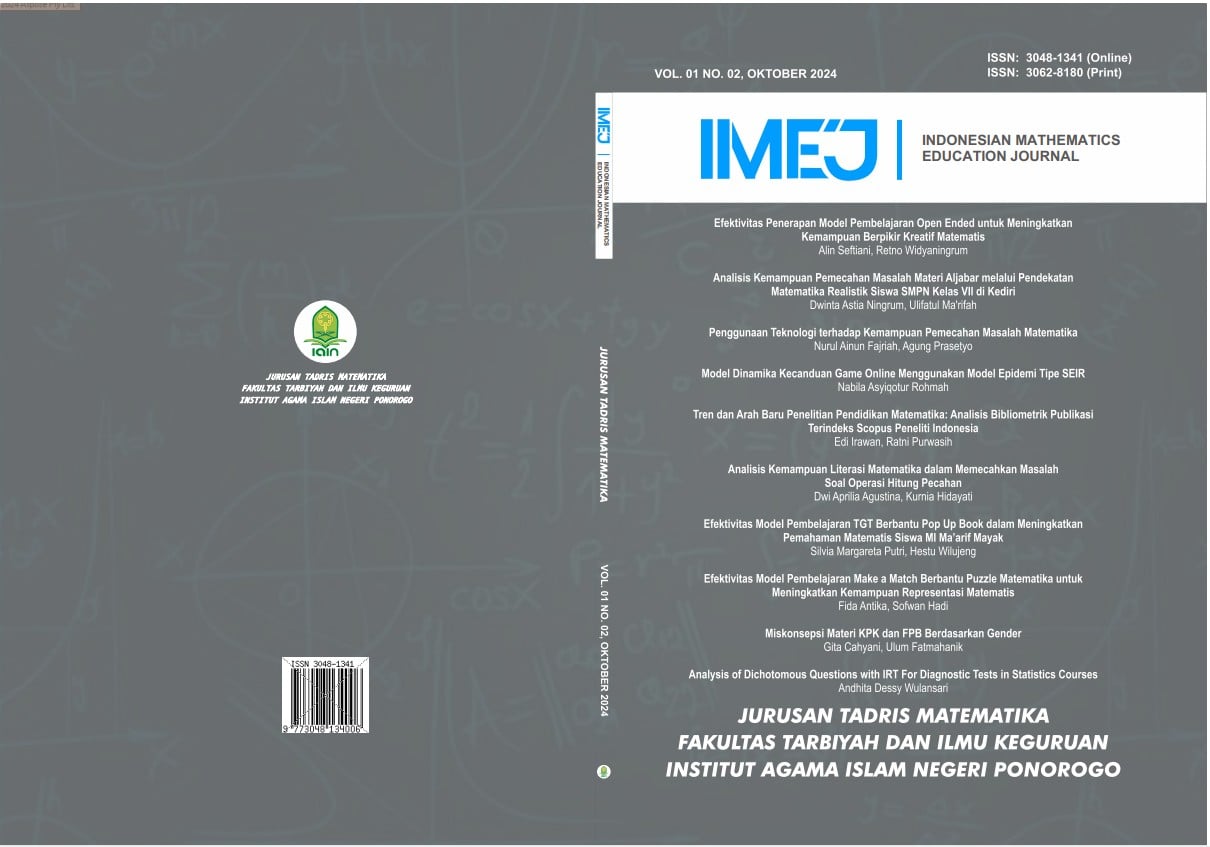
Tren dan Arah Baru Penelitian Pendidikan Matematika: Analisis Bibliometrik Publikasi Terindeks Scopus Peneliti Indonesia
DOI:
https://doi.org/10.21154/imej.v1i2.22Keywords:
mathematics education, bibliometric analysis, ethnomathematics, computational thinking, ScopusAbstract
Penelitian ini bertujuan untuk mengidentifikasi tren dan arah baru dalam penelitian pendidikan matematika yang dilakukan oleh peneliti Indonesia berdasarkan analisis bibliometrik terhadap publikasi yang terindeks di Scopus selama periode 1988 hingga 2024. Hasil penelitian menunjukkan adanya peningkatan signifikan dalam jumlah publikasi, terutama setelah tahun 2010, dengan fokus utama pada topik matematika realistik (PMRI), etnomatematika, self-regulated learning, dan pembelajaran daring. Topik-topik tersebut mencerminkan respons terhadap perkembangan teknologi, kebutuhan pembelajaran abad ke-21, serta upaya untuk mengintegrasikan pendekatan kontekstual dan budaya lokal dalam pembelajaran matematika. Kolaborasi internasional juga meningkat, dengan Belanda dan Malaysia menjadi mitra utama dalam penelitian pendidikan matematika di Indonesia. Implikasi teoretis dari penelitian ini menunjukkan pentingnya pendekatan berbasis konteks dan interdisipliner, sementara secara praktis, hasil ini menekankan perlunya pelatihan guru serta peningkatan infrastruktur teknologi untuk mendukung pembelajaran matematika yang lebih inklusif dan merata. Keterbatasan penelitian ini terletak pada cakupan data yang terbatas pada database Scopus, sehingga penelitian selanjutnya disarankan untuk memperluas basis data dengan mencakup publikasi lokal dan memperkuat kolaborasi dengan negara-negara lain. Dengan demikian, penelitian ini memberikan wawasan komprehensif tentang perkembangan penelitian pendidikan matematika di Indonesia serta potensi untuk pengembangan lebih lanjut dalam konteks global.
Downloads
References
Barton, B. (1999). Ethnomathematics: A Political Plaything. For the Learning of Mathematics, 19(1), 32–35.
Bornmann, L., & Mutz, R. (2015). Growth Rates of Modern Science: A Bibliometric Analysis Based on the Number of Publications and Cited References. Journal of the Association for Information Science and Technology, 66(11), 2215–2222. https://doi.org/10.1002/asi.23329
Cansız Aktaş, M. (2022). Problem-Posing Research in Mathematics Education: A Bibliometric Analysis. Journal of Pedagogical Research, 6(4), 217–233. https://doi.org/10.33902/JPR.202217414
Cevikbas, M., Kaiser, G., & Schukajlow, S. (2024). Trends in Mathematics Education and Insights from a Meta-Review and Bibliometric Analysis of Review Studies. ZDM – Mathematics Education, 56(2), 165–188. https://doi.org/10.1007/s11858-024-01587-7
Chen, H., Feng, Y., Li, S., Zhang, Y., & Yang, X. (2019). Bibliometric Analysis of Theme Evolution and Future Research Trends of the Type a Personality. Personality and Individual Differences, 150, 109507.
Chen, P.-Y., Hwang, G.-J., Yeh, S.-Y., Chen, Y.-T., Chen, T.-W., & Chien, C.-H. (2022). Three Decades of Game-Based Learning in Science and Mathematics Education: An Integrated Bibliometric Analysis and Systematic Review. Journal of Computers in Education, 9(3), 455–476. https://doi.org/10.1007/s40692-021-00210-y
Cobb, P. (2003). Investigating Students’ Reasoning about Linear Measurement as a Paradigm Case of Design Research. Journal for Research in Mathematics Education, 12, 1–16.
Cobo, M. J., López-Herrera, A. G., Herrera-Viedma, E., & Herrera, F. (2011). Science Mapping Software Tools: Review, Analysis, and Cooperative Study Among Tools. Journal of the American Society for Information Science and Technology, 62(7), 1382–1402. https://doi.org/10.1002/asi.21525
d’Ambrosio, U. (1985). Ethnomathematics and Its Place in the History and Pedagogy of Mathematics. For the Learning of Mathematics, 5(1), 44–48.
Deda, Y. N., Disnawati, H., Tamur, M., & Rosa, M. (2024). Global Trend of Ethnomathematics Studies of the Last Decade: A Bibliometric Analysis. Infinity Journal, 13(1), 233–250. https://doi.org/10.22460/infinity.v13i1.p233-250
Dede, E., & Ozdemir, E. (2022). Mapping and Performance Evaluation of Mathematics Education Research in Turkey: A Bibliometric Analysis from 2005 to 2021. Journal of Pedagogical Research, 6(4), 1–19. https://doi.org/10.33902/JPR.202216829
Ersozlu, Z., & Karakus, M. (2019). Mathematics Anxiety: Mapping the Literature by Bibliometric Analysis. EURASIA Journal of Mathematics, Science and Technology Education, 15(2). https://doi.org/10.29333/ejmste/102441
Galeano-Barrera, C. J., Arango Ospina, M. E., Mendoza García, E. M., Rico-Bautista, D., & Romero-Riaño, E. (2022). Exploring the Evolution of the Topics and Research Fields of Territorial Development from a Comprehensive Bibliometric Analysis. Sustainability, 14(11), 6515.
Gao, Y., Wong, S. L., Md. Khambari, M. N., & Noordin, N. (2022). A Bibliometric Analysis of Online Faculty Professional Development in Higher Education. Research and Practice in Technology Enhanced Learning, 17(1), 1–19. https://doi.org/10.1186/s41039-022-00196-w
Glí, W. (2012). Bibliometric Methods for Detecting and Analysing Emerging Research Topics. Profesional de La Informacion, 21(2), 194–201.
Gökçe, S., & Guner, P. (2021). Forty Years of Mathematics Education: 1980-2019. International Journal of Education in Mathematics, Science and Technology, 9(3), 514–539. https://doi.org/10.46328/ijemst.1361
Ha, C. T., Thao, T. T. P., Trung, N. T., Huong, L. T. T., Dinh, N. V., & Trung, T. (2020). A Bibliometric Review of Research on STEM Education in ASEAN: Science Mapping the Literature in Scopus Database, 2000 to 2019. Eurasia Journal of Mathematics, Science and Technology Education, 16(10), 1–11. https://doi.org/10.29333/ejmste/8500
Huang, C., Yang, C., Wang, S., Wu, W., Su, J., & Liang, C. (2020). Evolution of Topics in Education Research: A Systematic Review Using Bibliometric Analysis. Educational Review, 72(3), 281–297. https://doi.org/10.1080/00131911.2019.1566212
Irawan, E. (2024). Keterampilan Computational Thinking Mahasiswa Melalui Penerapan Desain Didaktis Dengan Memanfaatkan Perangkat Lunak-R Pada Mata Kuliah Statistika [PhD Thesis, Universitas Pendidikan Indonesia]. https://repository.upi.edu/
Irawan, E., & Herman, T. (2023). Trends in Research on Interconnection of Mathematics and Computational Thinking. AIP Conference Proceedings, 2805, 040025. https://doi.org/10.1063/5.0148018
Irawan, E., Kusumah, Y. S., & Saputri, V. (2023). Pengembangan Multimedia Interaktif Menggunakan Scratch: Solusi Pembelajaran di Era Society 5.0. AKSIOMA: Jurnal Program Studi Pendidikan Matematika, 12(1), Article 1. https://doi.org/10.24127/ajpm.v12i1.6226
Irawan, E., Rosjanuardi, R., & Prabawanto, S. (2024a). Advancing Computational Thinking in Mathematics Education: A Systematic Review of Indonesian Research Landscape. JTAM (Jurnal Teori Dan Aplikasi Matematika), 8(1), 176. https://doi.org/10.31764/jtam.v8i1.17516
Irawan, E., Rosjanuardi, R., & Prabawanto, S. (2024b). Research Trends of Computational Thinking in Mathematics Learning: A Bibliometric Analysis from 2009 to 2023. Eurasia Journal of Mathematics, Science and Technology Education, 20(3), em2417. https://doi.org/10.29333/ejmste/14343
Julius, R., Abd Halim, M. S., Abdul Hadi, N., Alias, A. N., Mohd Khalid, M. H., Mahfodz, Z., & Ramli, F. F. (2021). Bibliometric Analysis of Research in Mathematics Education using Scopus Database. Eurasia Journal of Mathematics, Science and Technology Education, 17(12), 1–12. https://doi.org/10.29333/ejmste/11329
Kadarisma, G., Juandi, D., & Darhim, D. (2024). Global Trends in Flipped Classroom Research Within Mathematics Education Over Past Two Decade: A Bibliometric Analysis. Infinity Journal, 13(2), 531–552. https://doi.org/10.22460/infinity.v13i2.p531-552
Larsen, P., & Von Ins, M. (2010). The Rate of Growth in Scientific Publication and the Decline in Coverage Provided by Science Citation Index. Scientometrics, 84(3), 575–603.
Mas-Tur, A., Kraus, S., Brandtner, M., Ewert, R., & Kürsten, W. (2020). Advances in Management Research: A Bibliometric Overview of the Review of Managerial Science. Review of Managerial Science, 14(5), 933–958. https://doi.org/10.1007/s11846-020-00406-z
Seidouvy, A., & Schindler, M. (2020). An Inferentialist Account of Students’ Collaboration in Mathematics Education. Mathematics Education Research Journal, 32(3), 411–431. https://doi.org/10.1007/s13394-019-00267-0
Skute, I., Zalewska-Kurek, K., Hatak, I., & De Weerd-Nederhof, P. (2019). Mapping the Field: A Bibliometric Analysis of the Literature on University–Industry Collaborations. The Journal of Technology Transfer, 44(3), 916–947. https://doi.org/10.1007/s10961-017-9637-1
Suseelan, M., Chew, C. M., & Chin, H. (2022). Research on Mathematics Problem Solving in Elementary Education Conducted from 1969 to 2021: A Bibliometric Review. International Journal of Education in Mathematics, Science and Technology, 10(4), 1003–1029. Scopus. https://doi.org/10.46328/ijemst.2198
Tsilika, K. (2023). Exploring the Contributions to Mathematical Economics: A Bibliometric Analysis Using Bibliometrix and VOSviewer. Mathematics, 11(22), Article 22. https://doi.org/10.3390/math11224703
Wing, J. M. (2006). Computational Thinking. Communications of the ACM, 49(3), 33–35. https://doi.org/10.1145/1118178.1118215
Wing, J. M. (2017). Computational Thinking’s Influence on Research and Education for All. Italian Journal of Educational Technology, 25(2), 7–14. https://doi.org/10.17471/2499-4324/922
Yığ, K. G. (2022). Research Trends in Mathematics Education: A Quantitative Content Analysis of Major Journals 2017-2021. Journal of Pedagogical Research, 3. https://doi.org/10.33902/JPR.202215529
Zhu, X., Turney, P., Lemire, D., & Vellino, A. (2015). Measuring Academic Influence: Not All Citations Are Equal. Journal of the Association for Information Science and Technology, 66(2), 408–427. https://doi.org/10.1002/asi.23179
Zimmerman, B. J. (2002). Becoming a self-regulated learner: An overview. Theory Into Practice, 41(2), 64–70. https://doi.org/10.1207/s15430421tip4102_2
Zulkardi, Z., Putri, R. I. I., & Wijaya, A. (2020). Two Decades of Realistic Mathematics Education in Indonesia. International Reflections on the Netherlands Didactics of Mathematics: Visions on and Experiences with Realistic Mathematics Education, 325–340.
Zupic, I., & Čater, T. (2015). Bibliometric Methods in Management and Organization. Organizational Research Methods, 18(3), 429–472. https://doi.org/10.1177/1094428114562629
Downloads
Published
Issue
Section
License
Copyright (c) 2024 IMEJ : Indonesian Mathematics Education Journal

This work is licensed under a Creative Commons Attribution-NonCommercial-ShareAlike 4.0 International License.
Authors who publish with this journal agree to the following terms:
- Authors retain copyright and grant the journal the right of first publication with the work simultaneously licensed under Creative Commons Attribution-NonCommercial 4.0 International License that allows others to share the work with an acknowledgment of the work's authorship and initial publication in this journal.
- Authors are able to enter into separate, additional contractual arrangements for the non-exclusive distribution of the journal's published version of the work (e.g., post it to an institutional repository or publish it in a book), with an acknowledgment of its initial publication in this journal.
- Authors are permitted and encouraged to post their work online (e.g., in institutional repositories or on their website) prior to and during the submission process, as it can lead to productive exchanges, as well as earlier and greater citation of published work (See The Effect of Open Access).
Reproducing Published Material from other Publishers
To ensure that published materials are properly cited and used, the authors are required to obtain permission to reproduce images, schematics, tables, or text excerpts that are not in the public domain or for which they are not copyrighted. The copyright holder, usually the publisher, must be contacted to obtain permission. Copyright holders can be identified by referring to individual publication imprints. Obtaining permission is necessary to avoid copyright infringement and to ensure that all relevant sources are properly cited.
The following actions require permission:
- Reproduction of your work by another publisher if you do not own the copyright.
- Use large portions of another person's work, either from a single work or multiple works in a series.
- Use of unaltered or slightly modified tables, graphs, charts, schematics, and artwork.
- Use of photographs for which you do not have copyright.
It is not necessary to obtain permission for the following reasons:
- If you reconstruct a table using data that has been published elsewhere, you must cite the source as “Data from...” or “Adapted from...” However, permission was not required for this case.
- Fairly brief citations are considered fair and do not require permission.
- If the author redraws the graph, chart, schematic, or artwork and changes it so significantly that it is no longer recognizable, permission is not required.
Obtaining Permission
To ensure a smooth publication process, it is recommended that authors begin obtaining permission as soon as possible. If there is any uncertainty regarding the copyright, the author should apply for permission. The IMEJ: Indonesian Mathematics Education Journal publish materials from other publications without their permission.
The copyright holder may provide instructions regarding the desired form of acknowledgment. If no instructions are provided, the authors follow the style below:
“Reproduced with permission from [author], [book/journal title]; published by [publisher], [year].” This statement should be placed at the end of the caption for the table, figure, or scheme.