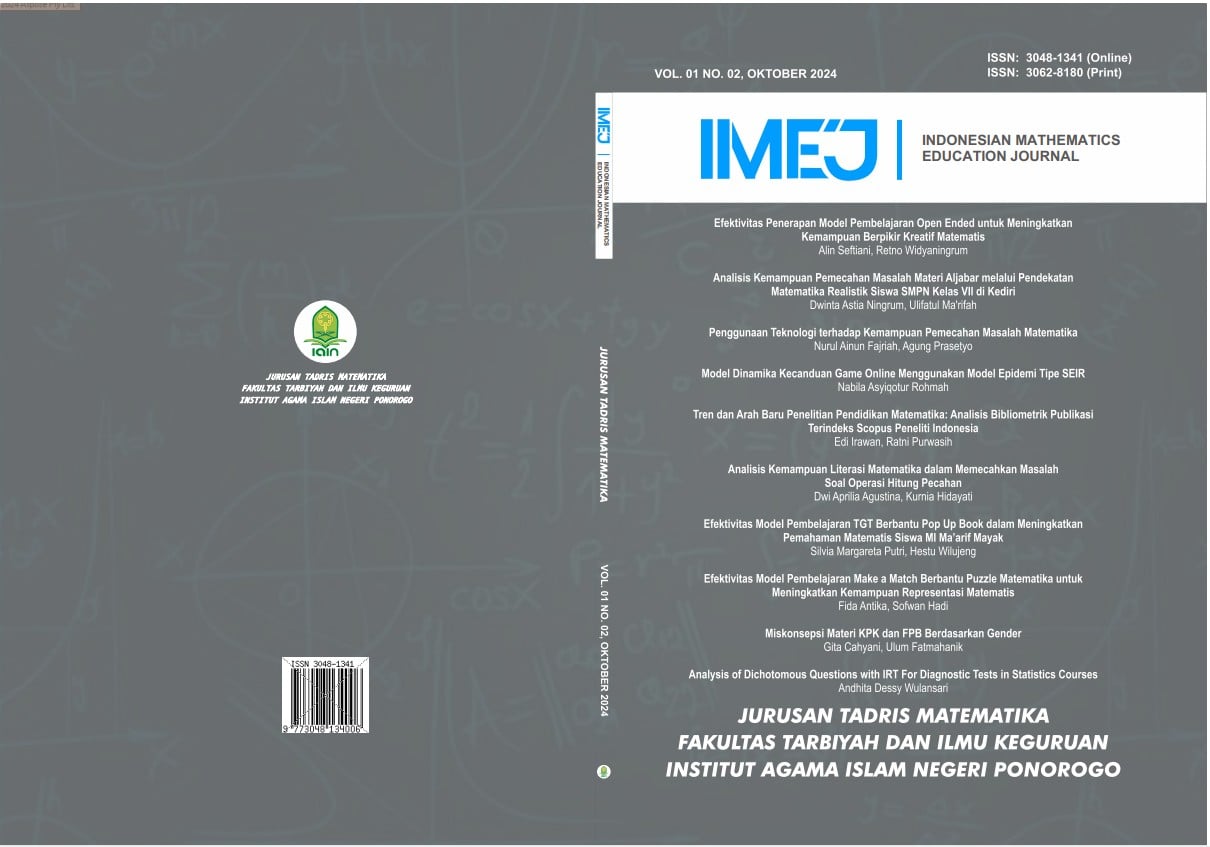
Analysis of Dichotomous Questions with IRT for Diagnostic Tests in Statistics Courses
DOI:
https://doi.org/10.21154/imej.v1i2.28Keywords:
Dichotomous, IRT, Diagnostic, StatisticsAbstract
The results of the question item analysis can be used as diagnostic information, whether students understand the concepts, have misconceptions, and need help understanding the concepts of the lecture's material. The diagnostic test here consists of 20 multiple-choice questions to identify the level of conceptual understanding of the primary statistics material in the introductory statistics course. In this study, researchers will conduct item analysis using Item Response Theory (IRT). This research aims to determine the questions' quality and the abilities of FTIK IAIN Ponorogo students. This research is evaluative research with a quantitative descriptive approach. The research results show that in terms of model suitability, based on the AIC, BIC, and log-likelihood criteria, itfor this case, the 1PL model is the most suitable compared to the 2PL and 3PL models. Based on the ICC 1PL curve, it can be seen that item number 9 is the most accessible item, and item number 4 is the most challenging item. to the right, the difficulty level of the question item is lower, and further to the left, the difficulty level of the question is higher. The estimated value of the person's ability (person) for each participant totaling 1000 people is symbolized by p1 to p1000. The test taker's ability (ϴ) varies from -3.45106849 to 3.38603802.
Downloads
References
Agustyaningrum, N., Sari, R. N., et al. (2021). Dominant Factors That Cause Students' Difficulties in Learning Abstract Algebra: A Case Study at a University in Indonesia. 14(1), 847-866.
Andariana, A., Zubaidah, S., et al. (2020). Identification of biology students’ misconceptions in human anatomy and physiology course through three-tier diagnostic test. 8(3), 1071-1085.
Bilad, M. R., Zubaidah, S., et al. (2024). Addressing the PISA 2022 Results: A Call for Reinvigorating Indonesia’s Education System. 3(1), 1-12.
Casella, G., & Berger, R. (2024). Statistical inference: CRC Press.
Gupta, S., & Kapoor, V. (2020). Fundamentals of mathematical statistics: Sultan Chand & Sons.
Hahs-Vaughn, D. L., & Lomax, R. G. (2020). An introduction to statistical concepts: Routledge.
Hambleton, R. K. (1991). Fundamentals of item response theory: Sage.
Hambleton, R. K., & Swaminathan, H. (2013). Item response theory: Principles and applications: Springer Science & Business Media.
Hiltunen, J., Ahonen, A., et al. (2023). PISA 2022 ensituloksia.
Hulin, C. L., Drasgow, F., et al. (1983). Item response theory: Application to psychological measurement.
Jonassen, D. H., & Carr, C. S. (2020). Mindtools: Affording multiple knowledge representations for learning. In Computers as cognitive tools (pp. 165-196): Routledge.
Kristidhika, D. C., Cendana, W., et al. (2020). Contextual teaching and learning to improve conceptual understanding of primary students. 2(2), 71-78.
Maki, P. L. (2023). Assessing for learning: Building a sustainable commitment across the institution: Routledge.
Mertler, C. A., Vannatta, R. A., et al. (2021). Advanced and multivariate statistical methods: Practical application and interpretation: Routledge.
Puspitasari, R., & Mufit, F. (2021). Conditions of learning physics and students’ understanding of the concept of motion during the covid-19 pandemic. Paper presented at the Journal of Physics: Conference Series.
Putra, A., & Hamidah, I. (2020). The development of five-tier diagnostic test to identify misconceptions and causes of students’ misconceptions in waves and optics materials. Paper presented at the Journal of Physics: Conference Series.
Retnawati, H. J. N. M. (2014). Teori respons butir dan penerapannya [Item response theory and its application].
Shultz, K. S., Whitney, D., et al. (2020). Measurement theory in action: Case studies and exercises: Routledge.
Sudirman, S., Son, A. L., et al. (2020). Uncovering the Students’ mathematical concept understanding ability: a based study of both students’ cognitive styles dependent and independent field in overcoming the problem of 3D Geometry. 10(1).
Suwono, H., Prasetyo, T. I., et al. (2021). Cell Biology Diagnostic Test (CBD-Test) portrays pre-service teacher misconceptions about biology cell. 55(1), 82-105.
Tumanggor, A., Kuswanto, H., et al. (2020). Using four-tier diagnostic test instruments to detect physics teacher candidates’ misconceptions: Case of mechanical wave concepts. Paper presented at the Journal of physics: conference series.
Widyaningsih, S. W., Yusuf, I., et al. (2021). The Development of the HOTS Test of Physics Based on Modern Test Theory: Question Modeling through E-Learning of Moodle LMS. 14(4), 51-68.
Wijaya, T. T., Hidayat, W., et al. (2024). Exploring contributing factors to PISA 2022 mathematics achievement: Insights from Indonesian teachers. 13(1), 139-156.
Zsido, A. N., Teleki, S. A., et al. (2020). Development of the short version of the spielberger state—trait anxiety inventory. 291, 113223.
Downloads
Published
Issue
Section
License
Copyright (c) 2024 IMEJ : Indonesian Mathematics Education Journal

This work is licensed under a Creative Commons Attribution-NonCommercial-ShareAlike 4.0 International License.
Authors who publish with this journal agree to the following terms:
- Authors retain copyright and grant the journal the right of first publication with the work simultaneously licensed under Creative Commons Attribution-NonCommercial 4.0 International License that allows others to share the work with an acknowledgment of the work's authorship and initial publication in this journal.
- Authors are able to enter into separate, additional contractual arrangements for the non-exclusive distribution of the journal's published version of the work (e.g., post it to an institutional repository or publish it in a book), with an acknowledgment of its initial publication in this journal.
- Authors are permitted and encouraged to post their work online (e.g., in institutional repositories or on their website) prior to and during the submission process, as it can lead to productive exchanges, as well as earlier and greater citation of published work (See The Effect of Open Access).
Reproducing Published Material from other Publishers
To ensure that published materials are properly cited and used, the authors are required to obtain permission to reproduce images, schematics, tables, or text excerpts that are not in the public domain or for which they are not copyrighted. The copyright holder, usually the publisher, must be contacted to obtain permission. Copyright holders can be identified by referring to individual publication imprints. Obtaining permission is necessary to avoid copyright infringement and to ensure that all relevant sources are properly cited.
The following actions require permission:
- Reproduction of your work by another publisher if you do not own the copyright.
- Use large portions of another person's work, either from a single work or multiple works in a series.
- Use of unaltered or slightly modified tables, graphs, charts, schematics, and artwork.
- Use of photographs for which you do not have copyright.
It is not necessary to obtain permission for the following reasons:
- If you reconstruct a table using data that has been published elsewhere, you must cite the source as “Data from...” or “Adapted from...” However, permission was not required for this case.
- Fairly brief citations are considered fair and do not require permission.
- If the author redraws the graph, chart, schematic, or artwork and changes it so significantly that it is no longer recognizable, permission is not required.
Obtaining Permission
To ensure a smooth publication process, it is recommended that authors begin obtaining permission as soon as possible. If there is any uncertainty regarding the copyright, the author should apply for permission. The IMEJ: Indonesian Mathematics Education Journal publish materials from other publications without their permission.
The copyright holder may provide instructions regarding the desired form of acknowledgment. If no instructions are provided, the authors follow the style below:
“Reproduced with permission from [author], [book/journal title]; published by [publisher], [year].” This statement should be placed at the end of the caption for the table, figure, or scheme.